
PRACTICE • PREPARE • PERFORM
ETHOS Exam Practice Test & Preparation
Prepare for the ETHOS Police Exam with realistic practice designed around the skills assessed by municipal police departments in British Columbia. Strengthen your writing and editing, reading comprehension, critical thinking, memory, observation and summarization skills with unlimited practice and detailed answer explanations.
- Full-Length, Mini & Skill-Specific Practice Tests
- Instant Scoring & Detailed Answer Explanations
- Unlimited Randomized Question Bank
- Money Back Pass Guarantee
- $79 - 6 Months Unlimited Access
- 96% Pass Rate
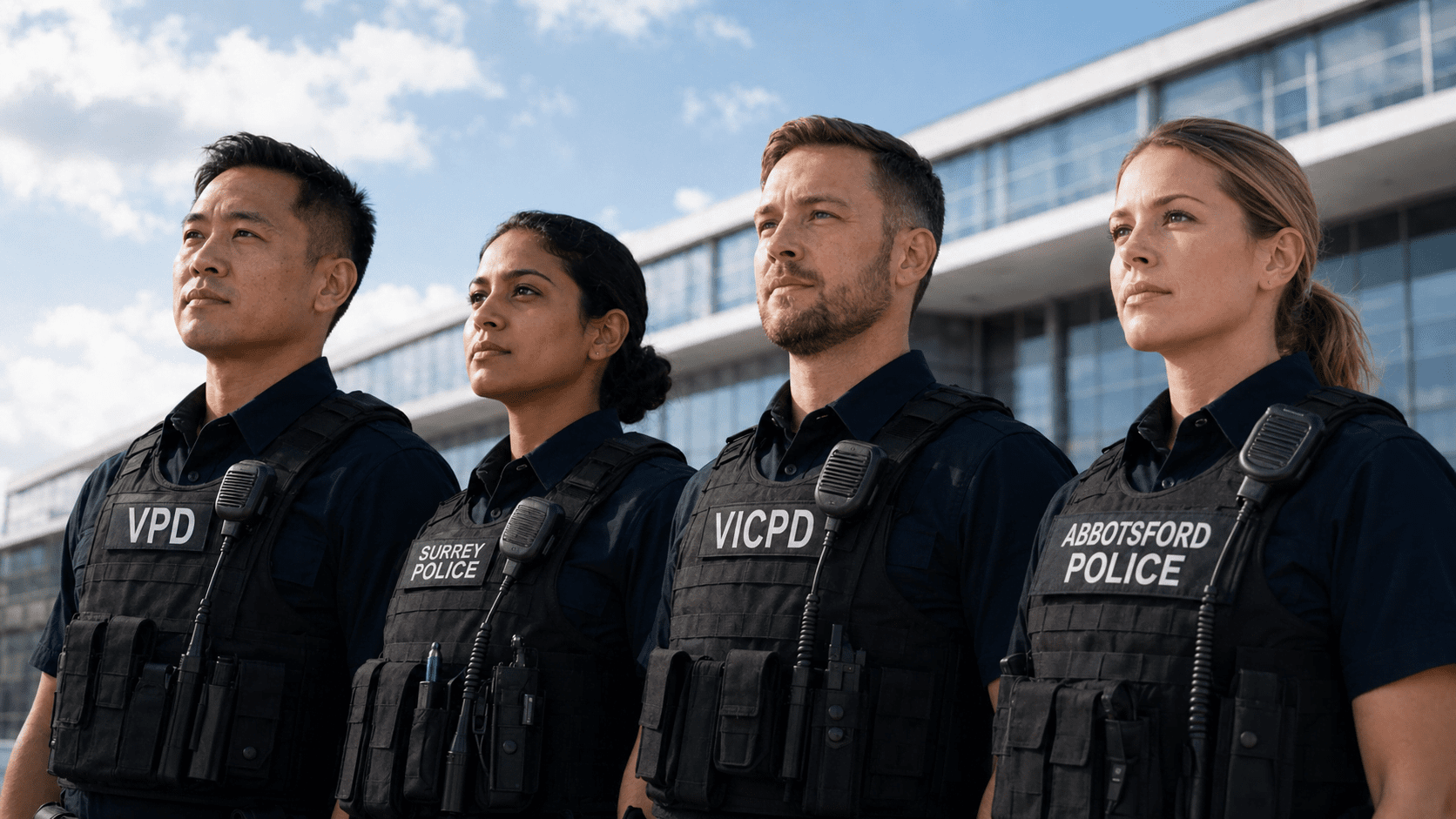
- Thousands of Canadian law-enforcement applicants have prepared with anEDGE.
- 100% Canadian Owned and Operated
- Former BC Officers, Recruiters & HR Experts
What Is the ETHOS Police Exam?
The ETHOS Police Exam is a three-hour practical skills assessment used by municipal police departments in British Columbia. It evaluates the abilities police officers regularly use in their work, including memory and observation, reading comprehension and critical thinking, summarization, and writing and editing.
The exam is used by several BC police agencies, including the Vancouver Police Department, Surrey Police Service, Delta Police Department, Victoria Police Department and Metro Vancouver Transit Police. Testing and passing-score requirements may vary by agency, so applicants should always confirm the current requirements with the department to which they are applying.
Preparing for a different Canadian police or law-enforcement entrance exam? Visit our Canadian Police Exam Prep Guide to compare RCMP, CBSA OTEE, OACP, APCAT, ETHOS and Corrections Canada preparation.
ETHOS at a Glance
- Feature
Details
Purpose
Practical skills assessment for municipal police applicants in British Columbia
Format
Written practical assessment; delivery procedures may vary by police agency
Length
Three hours
Total Marks
100 marks
Memory and Observation
20 marks
Reading Comprehension and Critical Thinking
25 marks
Summarization
10 marks
Writing and Editing
45 marks
Published Passing Score
60% (60/100); confirm the current requirement with your police department
Official source: Surrey Police Service — Overview of the ETHOS Police Test. Testing procedures and requirements may vary by police agency, so applicants should confirm current information directly with their department.
Why Applicants Struggle with the ETHOS Exam
Applicants often underestimate the level of written communication, concentration and time management required throughout the assessment.
Common challenges include:
- Weak grammar and written communication
- Rushing through memory and observation exercises
- Difficulty producing clear, concise summaries
- Missing important details in written material
- Struggling to balance speed with accuracy
- Running out of time during the exam
Effective preparation should include realistic, timed practice across each of the four ETHOS skill areas. This helps applicants identify weaker areas, improve accuracy and become more comfortable with the exam format.
Which BC Police Departments Use the ETHOS Exam?
The ETHOS Police Exam is used by several municipal police agencies throughout British Columbia as part of their constable recruitment process. It assesses practical skills such as memory and observation, reading comprehension and critical thinking, summarization, and writing and editing.
Police agencies that use or accept ETHOS exam results include:
- Vancouver Police Department
- Surrey Police Service
- Delta Police Department
- New Westminster Police Department
- Victoria Police Department
- Saanich Police Department
- Port Moody Police Department
- Central Saanich Police Service
- West Vancouver Police Department
- Metro Vancouver Transit Police
Testing procedures, passing scores and acceptance periods can vary by department. Always confirm the current requirements directly with the police agency to which you are applying
Why Applicants Upgrade to anEDGE
96% Reported Pass Rate
Based on results reported by applicants who completed our ETHOS EXAM preparation program.
Trusted by 15,500+ Canadian Applicants
Thousands of applicants have used our ETHOS practice exams to prepare with confidence.
Money-Back Pass Guarantee
Complete the required ETHOS practice exams, and if you do not pass the official ETHOS Exam, we will refund your purchase.
Unlimited Randomized Practice
Every attempt generates a different mix of questions, helping you develop real reasoning skills instead of memorizing answers.
Everything Included in Your ETHOS Preparation
Detailed Answer Explanations
Understand why an answer is correct and learn the reasoning needed to improve your performance.
Skill-Specific ETHOS Practice
Build your memory and observation, reading and critical thinking, summarization, and writing and editing skills.
Instant Results and Progress Tracking
Review your results, identify weaker areas, and measure your improvement after every attempt.
Developed by Experienced Professionals
Created by former BC officers and Canadian law-enforcement professionals familiar with public-safety hiring standards.
How to Pass the ETHOS Exam
Success on the ETHOS exam requires strong practical skills, careful time management and consistent accuracy across all four assessment modules.
- Memory and Observation: Focus on important people, actions, locations, sequences and identifying details.
- Reading Comprehension and Critical Thinking: Identify the main issue, distinguish relevant facts and draw conclusions supported by the information provided.
- Summarization: Capture the essential facts clearly and concisely without adding assumptions or unnecessary details.
- Writing and Editing: Review grammar, spelling, punctuation, sentence structure and clarity.
- Time Management: Practise under timed conditions so you can maintain accuracy throughout the three-hour assessment.
The most effective preparation combines skill-specific exercises with realistic, timed ETHOS-style practice.
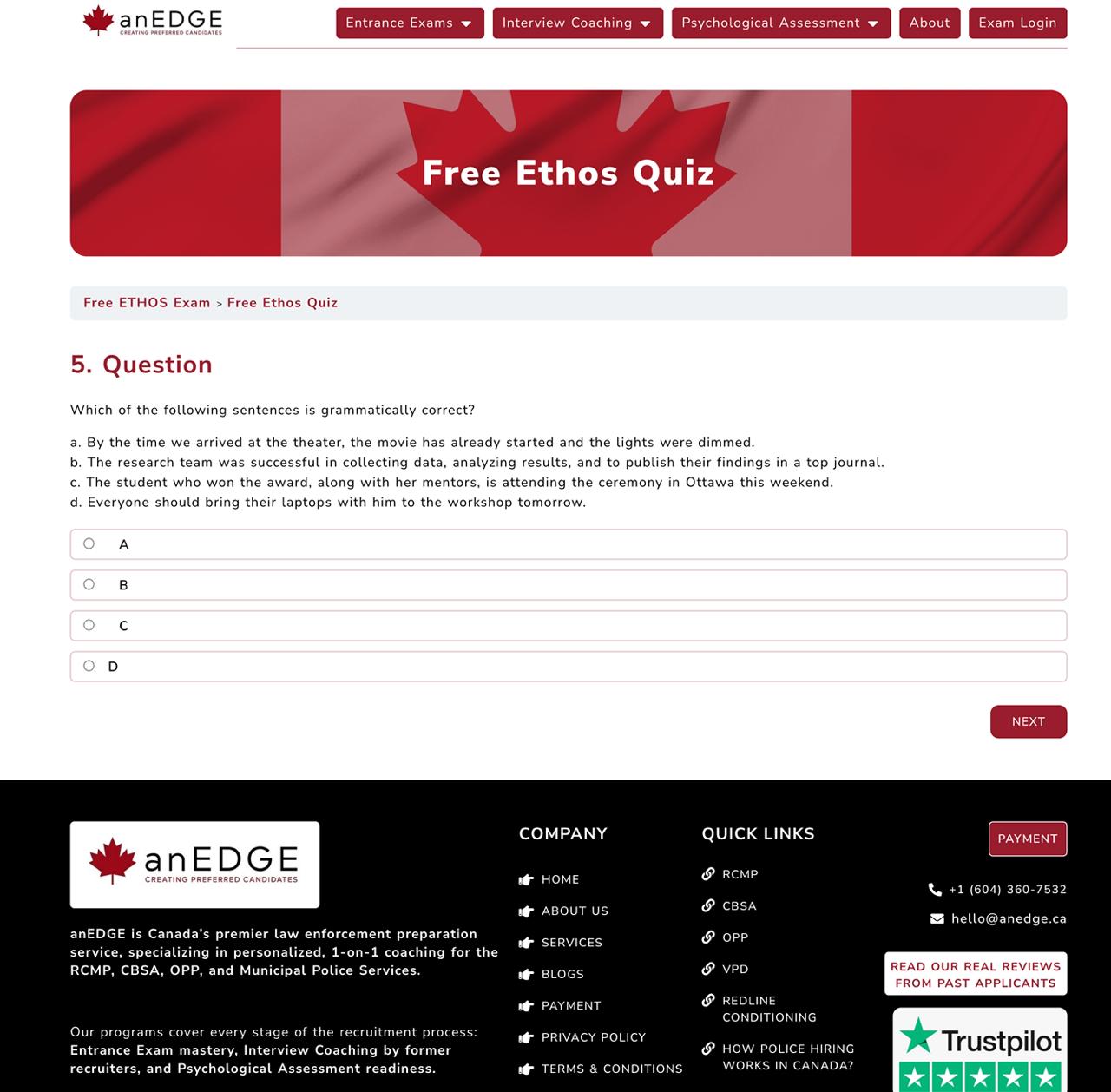
Try Three ETHOS-Style Practice Questions
Sample Question 1 —Writing & Editing Skills
You are reviewing a short report written by a colleague:
“The officer seen the suspect running and quickly responded, but there was several issues with communication and the situation escalated more than it should of.”
What is the MOST appropriate revision?
A) The officer seen the suspect running and responded quickly, but there was several communication issues.
B) The officer saw the suspect running and responded quickly, but there were several communication issues and the situation escalated more than it should have.
C) The officer saw the suspect running and quickly respond, but there was several issues with communication.
D) The officer seen the suspect running and responded quickly, but communication issues escalated.
Correct Answer: B
Explanation: This option corrects grammar, verb tense, and sentence structure while maintaining clarity and professionalism. Strong writing and editing skills are essential for clear police reporting.
Sample Question 2 — Reading Comprehension & Critical Thinking
You are given the following passage:
A patrol officer notices an increase in minor thefts in a specific area over several weeks. Most incidents occur during late evening hours near public transit stops.
What is the MOST reasonable conclusion?
A) The thefts are random and unrelated
B) The officer should ignore the pattern until more data is collected
C) The thefts may be linked to a consistent opportunity or pattern in that location and time
D) The thefts are being committed by multiple unrelated individuals with no pattern
Correct Answer: C
Explanation: Identifying patterns and drawing logical conclusions is a key component of critical thinking. The consistent timing and location suggest a predictable opportunity rather than random events.
Sample Question 3 —Summarization Skills
You are asked to summarize the following passage:
Police officers must gather information quickly, assess situations accurately, and communicate clearly with both the public and other officers. Strong communication helps prevent misunderstandings and ensures that incidents are handled safely and effectively.
Which is the BEST summary?
A) Police officers communicate with the public and other officers.
B) Communication is important for police officers in many situations.
C) Police officers must quickly assess situations and communicate clearly to handle incidents safely and effectively.
D) Officers gather information and communicate during incidents.
Correct Answer: C
Explanation: This option captures the key ideas of the passage while remaining concise and complete. Effective summarization requires identifying essential information without losing meaning.
Trusted by Canadian Police Applicants Nationwide
14 May, 2026
Amazing Experience- Interview Prep
Amazing experience, tailored the prep to what I needed. Extremely happy with the end result and I recommend their serivces. They will help you get the edge you need.
Andy
Ontario
1st July, 2026
ETHOS & Interview coaching has been amazing!
I’ve subscribed for the ETHOS course and the interview coaching, and it has been really helpful. I’ve scored in the mid 80s for ETHOS with the help of anEdge ETHOS course.
As for my interview, my coach, Tyra, has been amazing with the direction for my interview, and with her help, I’ve been gaining so much confidence. My interview will be scheduled soon and I’m already feeling close to being prepared.
Luke J
Vancouver
8th July , 2026
The best decision I’ve made is to…
The best decision I’ve made is to consult AnEdge, Kevin is awesome, so as his team and use this for all hiring steps and did not miss one. I am delighted for their existence!
Mimi
Ontario
25th June, 2025
Exactly the Confidence Boost I Needed
I had a great experience working with anEDGE to prepare for my CBSA interview. I reached out on pretty short notice before my interview, but Paul was flexible with his schedule and made it work, which I really appreciated.
The coaching was personalized, and instead of just giving me answers to memorize, Paul helped me understand how to structure my responses and think through the interview questions. I walked into my interview feeling confident and prepared. I’d definitely recommend anEDGE to anyone getting ready for a law enforcement interview.
Stathi P
Edmonton
15th June, 2026
Interview coaching and practice
The interview coaching and practice that anEDGE provides is extremely helpful. I had the pleasure of having a 1.5-hour session with Paul, and he was extremely helpful in preparing me for what to expect on my upcoming CBSA interview. The amount of information received is phenomenal, and I would highly recommend these coaching methods to anyone who has a serious interest in law enforcement. The price is more than fair with the amount of information that is given. Overall, anEDGE is an extremely caring company that strives for its clients’ success.
Taylor S
Ontario
3rd June 2026
I took a 3-session package
I took 3 session package. 2 coaching sessions and 1 full mock interview. I was preparing for edmonton police BDI interview. I found these coaching sessions really helpful, and passed my interview. I was told to focus on few things by my mentor from anedge. Thats exactly what was asked in the interview.
Gagan S
Ontario
18 Feb, 2026
Excellent experience with anEDGE
Excellent experience with anEDGE! I highly recommend this team to anyone preparing for professional exams. Thanks to their well-structured practice tests and the support provided through email exchanges, I successfully passed both of my exams within just two weeks: the Correctional Service exam and the Border Services exam. A huge thank you to the entire team for their professionalism and responsiveness. Special thanks to Mr. Kevin and Ms. Shana for their prompt replies, support, and professionalism. Your help truly contributed to my success. Thank you so much!
Herve
Ontario
20 Jun, 2026
Thank you anEDGE
Thank you so much Kevin, Elaine and the whole organization of anEDGE for helping me to pass the RCMP Suitability interview.
Elaine is an exceptional tutor. I learned exactly how to structure my answers using the STAR method. The practice questions perfectly mirrored the actual RCMP competency based behavioral and situational format. The feedback was honest, direct and highlighted even the small errors in my answers which I never would have noticed. Also, the mock interview really helped me to eliminate all my anxiety before the actual interview. I highly recommend anEDGE to anyone aspiring to a career in law enforcement.
AS
Winnipeg
ETHOS EXAM FAQ
What is the Ethos exam?
The ETHOS exam is a three-hour written skills assessment used by several municipal police departments in British Columbia. It evaluates practical abilities required in policing, including memory and observation, reading comprehension and critical thinking, summarization, and writing and editing. Applicants should confirm the current format and requirements with the police department to which they are applying.
How do you pass the Ethos exam?
To pass the ETHOS exam, prepare across its core skill areas: memory and observation, reading comprehension and critical thinking, summarization, and writing and editing. Use realistic timed practice, review your mistakes and develop a balance of speed and accuracy. Passing requirements can vary, so confirm the current standard with your police department.
What type of questions are on the Ethos exam?
The ETHOS exam includes questions and written exercises covering memory and observation, reading comprehension and critical thinking, summarization, and writing and editing. Candidates may need to recall important details, analyze written information, correct language errors and produce clear, concise summaries. The exact format may vary by police department.
Is the ETHOS exam hard?
The ETHOS exam can be challenging because it requires sustained concentration, strong written communication and careful time management. Candidates must remain accurate while completing memory, reading, critical-thinking, summarization, and writing exercises under timed conditions. Focused practice can help identify and strengthen weaker areas.
Can you study for the Ethos exam?
Yes. You can prepare by strengthening the specific skills assessed on the ETHOS exam rather than memorizing policing information. Effective preparation includes timed exercises in memory and observation, reading comprehension, critical thinking, summarization, grammar, spelling and written communication. Reviewing mistakes after each exercise is especially important.
Do I need policing knowledge to take the ETHOS exam?
No. The ETHOS exam assesses practical abilities rather than knowledge of police laws, procedures or terminology. Candidates should focus on developing their memory, observation, reading comprehension, critical thinking, summarization and written communication skills.
Which police departments use the Ethos exam?
The ETHOS exam is used or accepted by several municipal police agencies in British Columbia, including Vancouver, Surrey, Delta, New Westminster, Victoria, Saanich, Port Moody, Central Saanich, West Vancouver and Metro Vancouver Transit Police. Testing procedures and score-acceptance policies can change, so applicants should confirm the current requirements directly with their chosen department.
Is there a free ETHOS practice test?
Yes. anEDGE offers a free ETHOS practice test with sample questions covering the core skills assessed by the exam. It allows applicants to experience the question style, identify weaker areas and decide whether they need more comprehensive preparation.
How long is the Ethos exam?
The ETHOS exam is generally three hours long. Candidates complete several written sections assessing memory and observation, reading comprehension and critical thinking, summarization, and writing and editing. Applicants should confirm the current schedule and testing procedures with their police department.
Is the ETHOS exam online or in person?
The testing method depends on the police department. Some departments administer the ETHOS exam in person, and the Vancouver Police Department currently describes its entrance exam as handwritten. Applicants should not assume the exam is completed online and should confirm the current delivery method directly with their department
What does the Ethos exam measure?
The ETHOS exam measures practical skills required for police work, including memory and observation, reading comprehension and critical thinking, summarization, and writing and editing. It also assesses a candidate’s ability to remain accurate, organize information and communicate clearly under timed conditions.
Can you fail the Ethos exam?
Yes. Candidates can fail the ETHOS exam if their overall score does not meet the standard required by the police department. Vancouver Police currently publishes a passing mark of 60%, but requirements and competitive-score expectations may differ between agencies. Applicants should confirm the current standard with their department.
How is the ETHOS exam scored?
The ETHOS exam is generally scored out of 100 marks across four assessed areas: memory and observation, reading comprehension and critical thinking, summarization, and writing and editing. Each section contributes to the overall result, with writing and editing carrying the greatest weighting. Passing and competitive-score requirements may vary by police department.
What score should I aim for on the ETHOS exam?
Applicants should aim to score comfortably above their department’s minimum passing standard. Vancouver Police currently publishes a passing mark of 60%, but achieving 60% does not necessarily guarantee that an applicant will be competitive or advance. There is no single target score that applies to every police department.
How many times can I rewrite the ETHOS exam?
Rewrite rules depend on the police department administering the exam. For example, Surrey Police currently requires an unsuccessful applicant to wait six months before requesting a second opportunity. Other departments may have different waiting periods or limits, so confirm the current policy directly with your chosen agency.
What happens after the Ethos exam?
Applicants who meet the required ETHOS exam standard may continue to the next stages of their police department’s recruitment process. Depending on the agency, these stages can include physical testing, interviews, integrity and background reviews, psychological assessment and medical screening. The sequence and requirements vary by department.