
Ethos Exam (Canada): Practice Test & Preparation Guide
Prepare for the writing-focused Ethos police exam with realistic scenarios, editing tasks, and critical thinking.
- Built for modern Canadian police assessments
- Realistic Ethos-style writing, editing & decision-making tasks
- Improve your critical thinking and situational judgment
- Develop the skills tested on the actual Ethos exam
- Walk into your Ethos exam confident and prepared
$79
90 Days Access Extended free by Request
Designed to reflect the real Ethos exam used in British Columbia police recruitment.
Backed by Our 100% Money-Back Guarantee
What Is the Ethos Exam?
The Ethos exam is a situational judgment and decision-making assessment used in modern law enforcement hiring.
It is designed to evaluate how candidates think, respond, and make ethical decisions in realistic policing scenarios.
The Ethos exam is primarily used by police services in British Columbia, including departments such as the Vancouver Police Department. However, applicants across Canada frequently search for Ethos exam preparation as part of the broader police hiring process.
Ethos Exam Format and Structure
The Ethos exam is structured around four core modules that assess the key skills required for police work:
Writing & Editing Skills (45%)
Reading Comprehension & Critical Thinking (25%)
Memory & Observation Skills (20%)
Summarization Skills (10%)
The exam is typically completed in a single sitting and is scored out of 100. A minimum score of 60% is required to pass, although most competitive applicants aim for significantly higher scores.
Why Writing Skills Matter Most on the Ethos Exam
The Ethos exam places a strong emphasis on written communication, with writing and editing accounting for the largest portion of your final score.
Candidates are expected to:
Write clearly and professionally
Correct grammar and sentence structure
Communicate information concisely
This reflects real policing duties, where clear and accurate report writing is essential.
Why Most Applicants Struggle with the Ethos Exam
Many applicants underestimate the Ethos exam because it is not a traditional multiple-choice test.
The biggest challenges include:
Writing under time pressure
Identifying key information quickly
Maintaining accuracy without overthinking
Success comes from preparation that reflects the exam’s actual structure — not just general study.
What to Expect on Test Day
The Ethos exam is typically completed in a single sitting and requires sustained focus throughout.
Candidates must:
Work efficiently under time pressure
Read and process large amounts of information
Maintain accuracy across multiple written tasks
Unlike many other exams, performance depends on both speed and precision.
What’s Included in Your Ethos Practice Exam
- Full-Length Ethos-Style Practice Exams – Unlimited attempts with new scenarios generated
- Realistic Situational Judgement Questions based on law enforcement scenarios
- Focus on Decision-Making, Ethics, and Professional Judgment
- Aligned to modern police and public safety hiring standards
- Realistic Exam Difficulty and Scenario-Based Testing
- Instant Feedback & Performance Breakdown
- improve your response selection and reasoning skills
- Trusted by applicants preparing for law enforcement careers across Canada
How to Pass the Ethos Exam
Passing the Ethos Exam requires more than just knowledge — it requires strong judgement, professionalism, and the ability to respond appropriately in real-world scenarios.
Top-performing candidates consistently demonstrate the ability to think critically, communicate effectively, and make ethical decisions under pressure.
Key Strategies to Succeed on the Ethos Exam
Focus on professional and balanced responses
Always choose answers that reflect professionalism, respect, and sound judgement.Avoid extreme or reactive decisions
The Ethos Exam rewards measured responses over emotional or impulsive reactions.Consider the impact of your actions
Strong candidates think about how their decisions affect colleagues, the public, and the organization.Demonstrate accountability and integrity
Take responsibility and choose options that reflect honesty and ethical behaviour.Practice realistic scenarios
The more exposure you have to situational judgement questions, the more confident and consistent your responses will become.
Why Practice Is Critical
The Ethos Exam is designed to assess how you think — not what you memorize.
Practicing realistic scenarios helps you:
Recognize patterns in questions
Improve your decision-making speed
Build confidence before test day
Reduce uncertainty and anxiety
The most effective way to prepare is to use realistic Ethos-style practice exams that simulate the scenarios you will face on test day.
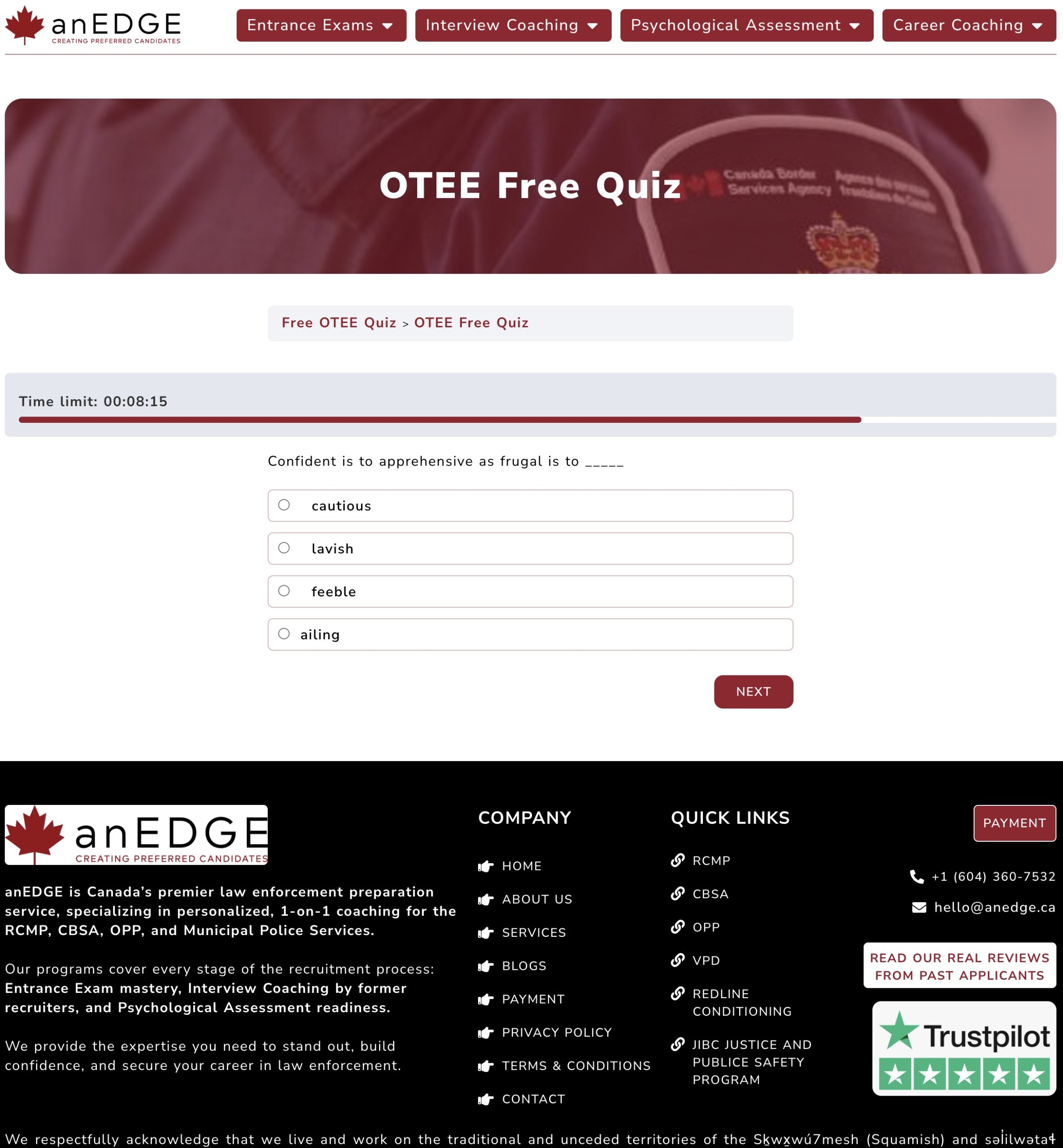
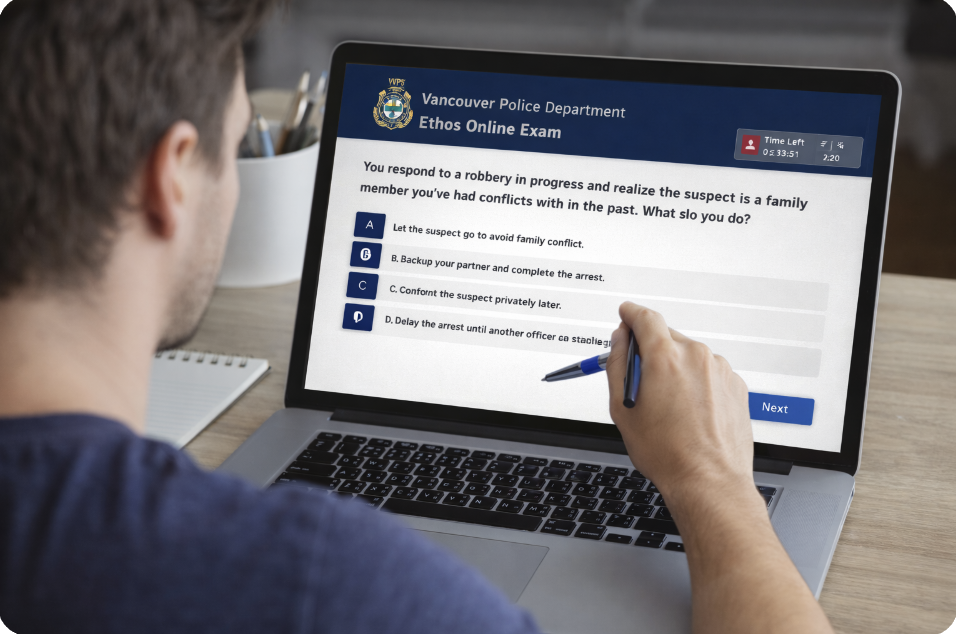
Try a Real Ethos-Style Practice QuestionGet a feel for the judgement, decision-making, and ethical reasoning questions used in modern law enforcement assessments.
Sample Question 1 — Professionalism & Accountability
You notice a colleague has been cutting corners on a task, which could affect the quality of work being delivered. You are not their supervisor.
What is the MOST appropriate action?
A) Ignore the issue and focus on your own work
B) Report the colleague immediately to a supervisor
C) Speak to the colleague privately and address your concerns
D) Publicly point out the issue to ensure it stops
Correct Answer: C
Explanation: Addressing the issue privately demonstrates professionalism, respect, and accountability. It allows the concern to be handled constructively without unnecessary escalation.
Sample Question 2 — Integrity & Decision-Making
You are asked to complete a task quickly, but doing so would require skipping an important step in the process.
What should you do?
A) Skip the step to meet expectations
B) Complete the task properly, even if it takes more time
C) Ignore the task entirely
D) Ask a colleague to take responsibility
Correct Answer: B
Explanation: Maintaining integrity and following proper procedures is critical in law enforcement roles. Cutting corners can lead to larger issues and reflects poor judgement.
Sample Question 3 — Communication & Judgement
A member of the public becomes frustrated and raises their voice while you are assisting them.
What is the MOST appropriate response?
A) Respond with the same tone to assert authority
B) End the interaction immediately
C) Remain calm and continue assisting professionally
D) Ignore the individual
Correct Answer: C
Explanation: Remaining calm and professional demonstrates emotional intelligence and strong communication skills. De-escalation is a key component of effective decision-making.
100% Money-Back Pass Guarantee
We’re confident our Ethos exam preparation system will help you perform at your best — and we want you to feel confident too.
If you complete our practice exams and are not satisfied with your preparation, we will refund your full purchase price. No questions asked.
✔ Zero risk
✔ Zero hassle
✔ Full confidence
Our goal is simple: If you’re not confident, you shouldn’t pay. Your success is our success — and we stand behind every practice exam we create.
Be Fully Prepared for the Ethos Exam
The Ethos Exam is designed to assess judgement, decision-making, and professionalism in real-world scenarios.
With the right preparation, you can approach the exam with clarity, confidence, and a clear understanding of what is expected.
anEDGE gives you the structure, realism, and practice you need to perform at your best on test day.
If you’re ready to take the next step in your law enforcement career, start preparing with realistic Ethos-style practice exams trusted by applicants across Canada.
Frequently Asked OTEE Questions
What is the Ethos exam?
The Ethos exam is a situational judgment test used by some Canadian police services to evaluate a candidate’s ethics, decision-making, and judgment in real-world policing scenarios.
How do you pass the Ethos exam?
To pass the Ethos exam, candidates must demonstrate strong ethical reasoning, sound judgment, and the ability to make decisions aligned with police values such as integrity, accountability, and professionalism.
What type of questions are on the Ethos exam?
The Ethos exam includes situational judgment questions where candidates must choose the best response to realistic policing scenarios involving ethics, teamwork, and decision-making.
Is the Ethos exam hard?
The Ethos exam can be challenging because it is not knowledge-based. Instead, it tests how you think and respond to complex situations, making preparation essential.
Can you study for the Ethos exam?
Yes, you can prepare for the Ethos exam by practicing situational judgment questions, understanding police competencies, and learning how to respond appropriately to ethical dilemmas.
What is a situational judgment test in policing?
A situational judgment test presents real-life scenarios and asks candidates to select the most appropriate response, assessing judgment, ethics, and decision-making skills.
Which police departments use the Ethos exam?
The Ethos exam is primarily used by police services in British Columbia, including departments such as the Vancouver Police Department and other regional agencies.
How long is the Ethos exam?
he length of the Ethos exam can vary by police service, but it typically consists of multiple situational questions completed within a timed online format.
Is the Ethos exam online?
Yes, the Ethos exam is usually conducted online, allowing candidates to complete the assessment remotely as part of the police hiring process.
What does the Ethos exam measure?
The Ethos exam measures ethical decision-making, judgment, integrity, communication, and the ability to handle complex situations in a policing context.
Can you fail the Ethos exam?
Yes, candidates can fail the Ethos exam if their responses do not align with expected policing values or demonstrate poor judgment in key scenarios.
How is the Ethos exam scored?
The Ethos exam is scored based on how closely a candidate’s responses align with ideal policing behaviors, including integrity, accountability, and professionalism.
How do I prepare for the Ethos police exam in Canada?
To prepare, candidates should practice realistic scenarios, review police competencies, and develop structured decision-making strategies aligned with Canadian policing standards.
What happens after the Ethos exam?
After completing the Ethos exam, successful candidates typically move forward in the hiring process, which may include interviews, background checks, and psychological assessments.