
Ontario Police Test Practice - OACP Exam Prep
How to Pass the OACP Exam (2026 Guide)
If you’re trying to learn how to pass the OACP exam in 2026, this guide explains everything you need to know
- Understand every section of the 2026 OACP exam
- Learn what the test measures and how it’s scored
- Build confidence with realistic study strategies and examples
Rated ★★★★★ on Trustpilot by Canadian Law Enforcement Applicants
Thinking about starting a policing career in Ontario?
The OACP Certificate is the first significant step in the Ontario police hiring process, and the updated 2026 OACP exam measures your cognitive ability, written communication skills, judgment, and overall readiness for policing. When you’re ready to start practicing, you can find realistic OACP practice exams here.
If you’re trying to learn how to pass the OACP exam, this OACP Exam Study Guide explains everything you need to know — how the test works, what’s on it, how difficult it is, and how to prepare effectively.
You can use this page as your complete educational resource before you begin preparing, and when you’re ready, you can see a sample OACP exam or a complete set of OACP practice exams
What Is the OACP Exam and What Does It Measure?
The OACP exam is a standardized assessment used across Ontario to evaluate whether an applicant has the core skills, judgment, and communication abilities required for policing.
It is part of the OACP Certificate process. It includes cognitive testing, written communication tasks, and situational judgment scenarios designed to measure how well you think, write, and make decisions under pressure.
The 2026 OACP exam follows an updated competency model that focuses on four major areas of policing readiness. Each section of the test highlights a different part of your decision-making, reasoning, and communication skills, giving police services a clearer picture of your overall suitability for the job.
The exam is divided into four major competency areas. Each section is designed to show how you think, communicate, and make decisions in police-relevant situations.
1
Cognitive Assessment
(2026 Format)
The Cognitive Assessment evaluates the core reasoning skills required for modern policing.
In the 2026 OACP Certificate Test, this section measures how well you interpret information, recognize patterns, and make decisions under time pressure.
Applicants may be tested on:
• Deductive reasoning
• Inductive reasoning
• Basic math and numerical logic
• Pattern recognition
• Attention to detail
• Quick decision-making
These skills form the foundation of the OACP exam and are essential for handling real policing tasks.
2
Written Communication (2026 Standard)
This part of the OACP exam assesses your ability to communicate clearly and professionally.
The Written Communication component evaluates whether you can produce accurate, well-structured written work suitable for police reports and official documentation.
You will be evaluated on:
• Grammar and sentence clarity
• Vocabulary understanding
• Punctuation and spelling
• Professional writing tone
• Ability to express information concisely
Strong writing is critical in policing, as officers must record details accurately and consistently.
3
Situational Judgement
(Policing Scenarios)
The OACP exam now uses a competency-based scoring model. Rather than focusing only on correct answers, the assessment looks at how well you display the key competencies required for policing.
Candidates are evaluated on:
• Logical thinking
• Clear communication
• Sound decision-making
• Consistency under pressure
• Accurate interpretation of information
• Structured reasoning
Police services use these competencies to determine overall readiness for the Ontario police hiring process.
4
Competency-Focused Scoring (2026 Model)
The OACP exam now uses a competency-based scoring model. Rather than focusing only on correct answers, the assessment looks at how well you display the key competencies required for policing.
Candidates are evaluated on:
• Logical thinking
• Clear communication
• Sound decision-making
• Consistency under pressure
• Accurate interpretation of information
• Structured reasoning
Police services use these competencies to determine overall readiness for the Ontario police hiring process.
How Difficult Is the 2026 OACP Exam?
The OACP exam can be challenging, especially for applicants who have not recently completed academic testing or timed assessments.
The 2026 version places greater emphasis on competency-based decision-making, clear written communication, and cognitive reasoning under pressure.
Many applicants struggle not because the material is unfamiliar, but because the exam requires you to think quickly, accurately, and professionally in police-relevant situations.
Common areas applicants find difficult include:
• Completing cognitive questions under strict time limits
• Identifying grammar and writing errors quickly
• Choosing the most appropriate response in judgment scenarios
• Interpreting information accurately under pressure
• Maintaining consistency across all competency areas
The good news: with structured preparation and realistic practice tests, the difficulty of the OACP exam becomes far more manageable. Understanding the format and practicing under exam-like conditions are the strongest predictors of success.
The OACP Cognitive Test Breakdown
The OACP Cognitive Test Breakdown (SSPO Section B)
The Cognitive section of the OACP exam evaluates how well you can reason, interpret patterns, and analyze information under time pressure. These skills are essential in policing, where officers must make quick and accurate decisions based on limited information.
You may encounter questions involving:
• Pattern Recognition: identifying trends, shapes, and logical sequences
• Deductive Reasoning: selecting the correct conclusion from given rules
• Inductive Reasoning: drawing general conclusions from specific examples
• Spatial Awareness: mentally manipulating shapes or diagrams
• Basic Math: arithmetic, word problems, and number logic
• Decision-Making: choosing the best response within strict time limits
What This Section Measures
These skills predict an applicant’s ability to process information quickly and accurately during police-relevant situations, especially when time and pressure are factors.
Written Communication Test
This portion of the OACP exam evaluates your ability to write clearly, professionally, and with attention to detail. Strong written skills are critical for accurate report writing and documenting events in policing.
Expect to be evaluated on:
• Spelling and grammar
• Sentence clarity and structure
• Vocabulary and word choice
• Punctuation and formatting
• Professional writing tone
• Ability to summarize or correct written material
Accurate, concise writing is one of the most important skills for an Ontario police applicant, and this section helps assess whether you can communicate clearly and consistently.
What This Section Measures
These skills predict an applicant’s ability to process information quickly and accurately during policing tasks.
Written Communication Test
Expect to be evaluated on:
Spelling, Grammar, Sentence clarity, Punctuation, Vocabulary, Structure, Ability to write clearly, professionally, and concisely and You may also be asked to summarize paragraphs or correct errors.
Tips for Success
- Not understanding the structure before writing the test
Writing long, unclear answers
Rushing pattern and logic questions
Poor grammar and spelling
Not practicing under time limits
Ignoring cognitive weaknesses instead of improving them
Understanding how to pass the OACP exam requires practice, familiarity with the test structure, and strong writing and reasoning skills.
Sample OACP-Style Questions
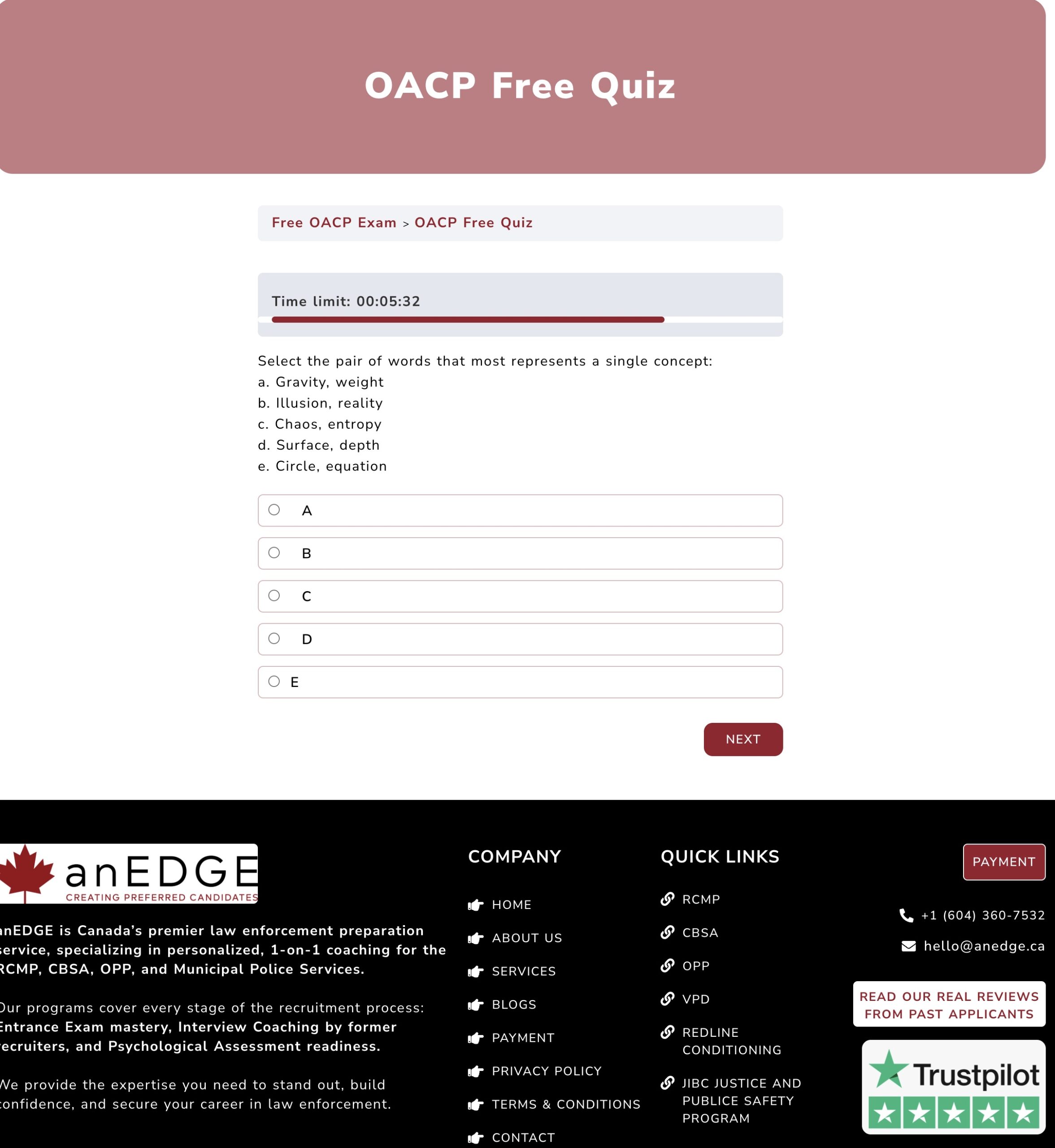
Sample Logic Question
If all recruits are required to attend training and some training sessions occur on weekends, which statement must be true?
A) All recruits attend on weekends
B) Some training may happen on weekends
Correct answer: B
Sample Written Communication Question
Choose the correctly written sentence:
A) The officer, walked to the car.
B) The officer walked to the car.
Correct answer: B
Common Mistakes OACP Applicants Make
- Not understanding the structure before writing the test
Writing long, unclear answers
Rushing pattern and logic questions
Poor grammar and spelling
Not practicing under time limits
Ignoring cognitive weaknesses instead of improving them
Understanding how to pass the OACP exam requires practice, familiarity with the test structure, and strong writing and reasoning skills.
Curious about 2026 OACP Preparation Today
If you want realistic exam-style practice with timed simulations, you can explore full-length OACP practice tests here:
anEDGE OACP OPP resource links
1. OACP Exam Prep: Full-Length 2026 Practice Tests
2. Police Interview Coaching (Ontario Services: OPP, Toronto, Peel, York, Durham, Ottawa): OPP Interview Coaching & Police Interview Coaching
3. Police Psychological Assessment Coaching (OPP / Municipal Services): OPP Psychological Assessment Prep
4. Police Entrance Exams in Canada — What’s Changing for 2026?: Police Exams
5. How to Prepare for Behaviour-Based Interview Questions (2026 Guide): OPP Interview Prep: How to Get Ready for the Ontario Provincial Police Interview
6. OACP vs Other Canadian Police Exams — What Applicants Should Know: police exams landing page
Frequently Asked Questions
What is the OACP exam?
The OACP exam is the standardized testing requirement for police applicants in Ontario. It evaluates cognitive skills, written communication, judgment, and behavioral traits to determine readiness for police work.
How hard is the OACP exam?
Most applicants find the exam moderately difficult, mainly because:
It is strictly timed.
Many questions are unfamiliar (patterns, reasoning, number logic).
The writing test requires precision.
With structured practice, the difficulty drops significantly.
Who needs to take the OACP exam?
Most — but not all — Ontario police services require a valid OACP Certificate before you can apply. Always check the recruitment requirements of the specific police service you intend to apply for
What does the exam consist of (i.e. what are the sections)?
The OACP exam comprises:
A Cognitive Assessment (reasoning, pattern recognition, basic math/number logic, decision-making under time pressure). anEDGE
A Written Communication Test (testing grammar, punctuation, spelling, vocabulary, sentence structure). anEDGE
A Situational / Judgement (Personality / Scenario-based) Assessment — to gauge behavioural traits, judgment, professionalism, and how candidates respond to policing-style scenarios. anEDGE
Supplementary components: a Fitness Log, plus Medical, Vision, and Hearing standards as part of fitness/health screening
What exactly is on the 2026 OACP Exam?
The OACP exam includes three major components:
Cognitive Test (SSPO Part B): reasoning, logic, pattern recognition, inductive/deductive reasoning, math basics.
Written Communication Test: spelling, grammar, vocabulary, sentence editing.
Situational Judgement / Personality Assessment: policing-style behavioural scenarios and trait-based questions.
This is the most accurate breakdown for 2026.
What is included in the Written Communication section?
The OACP exam includes three major components:
Cognitive Test (SSPO Part B): reasoning, logic, pattern recognition, inductive/deductive reasoning, math basics.
Written Communication Test: spelling, grammar, vocabulary, sentence editing.
Situational Judgement / Personality Assessment: policing-style behavioural scenarios and trait-based questions.
This is the most accurate breakdown for 2026.
How long is the OACP Certificate valid?
The OACP Certificate is valid for 12 months from the date of issuance.
How long is the OACP Certificate valid?
The OACP Certificate is valid for 12 months from the date of issuance.
Is the OACP exam proctored online?
Yes. The exam is completed online with live or automated proctoring, meaning you’ll need a quiet space, a webcam, your ID, and a reliable Internet connection. The system monitors your test session for security.
How long is the OACP exam?
The exam typically takes 90–120 minutes, depending on how long you spend on the situational and writing sections.
Do I need to study for the OACP exam?
Yes — while some sections rely on natural reasoning ability, timing and format familiarity matter. Candidates who practice:
Score higher
Finish more questions
Reduce test-day stress
This page exists to give you the study foundation.
What score do I need to pass the OACP exam?
The OACP does not publish exact scoring thresholds, but applicants must meet competency benchmarks across cognitive reasoning, writing ability, and behavioural traits. Practicing with full simulations helps you reach these benchmarks.
How quickly can I improve my OACP test results?
Most applicants see significant improvement within 1–3 weeks using structured practice tests, writing exercises, and behavioural preparation tailored to the current OACP standards.
How quickly can I improve my OACP test results?
Most applicants see significant improvement within 1–3 weeks using structured practice tests, writing exercises, and behavioural preparation tailored to the current OACP standards.
What is the best way to prepare for the OACP exam?
The most effective preparation approach includes:
Practicing timed cognitive tests
Doing writing skill drills
Reviewing situational judgment scenarios
Using practice exams designed for the current 2025–2026 structure
This aligns perfectly with your guide and the products you sell.
Do I receive my OACP exam results?
No. You do not receive detailed scores or section breakdowns. Results are sent directly to participating police services, who decide whether to advance you in their hiring process.