
2026 GUIDE FOR ONTARIO POLICE APPLICANTS
OACP Exam Guide: Certificate Tests, Format & Preparation
This complete guide explains the current OACP Certificate process, including the Part B SSPO cognitive assessment, the Part C PRF-R personality assessment, test format and timing, results, certificate validity and practical preparation strategies.
- Current SSPO and PRF-R Format
- 74 SSPO Questions in 35 Minutes
- Certificate Process Explained
- Practical Preparation Strategies
Updated August 2026 using current information published by the OACP Certificate Program and SIGMA Assessment Systems. anEDGE is an independent preparation company and is not affiliated with or endorsed by either organization.
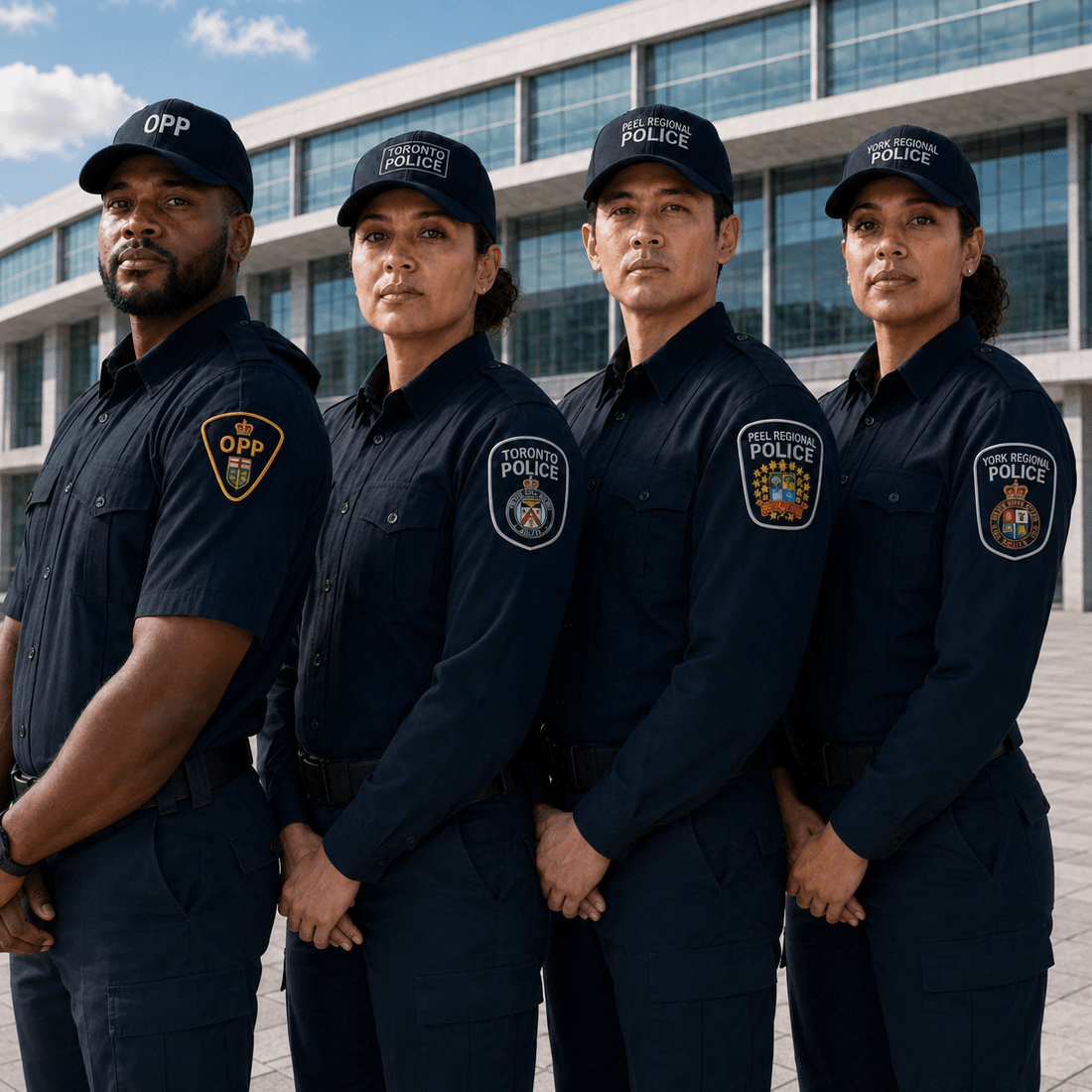
- National Team of Former Police, RCMP, CBSA Officers, Recruiters & HR Specialists
- 100% Canadian Owned and Operated
OACP Certificate: Quick Facts
The OACP Certificate process includes two online assessments completed during a scheduled proctored session. Here is the current testing structure applicants should understand before beginning their preparation.
Part B: SSPO
- 74 multiple-choice questions completed in 35 minutes
- 44 Incident Report Writing Aptitude questions
- 30 Police Problem Solving questions
- Incorrect answers receive a penalty
- Unanswered questions are not penalized
Part C: PRF-R for Policing
- 307 personality statements
- Measures policing-related personality characteristics
- Uses a five-point agreement scale
- There are no correct or incorrect answers
- Most applicants complete it in approximately 20–30 minutes
Certificate Information
- Feature
Details
Testing format
Online and proctored
Current cost
$250 CAD before tax
Certificate validity
One year
Retesting
Permitted after 10 months
Results
Shared with the police services you apply to.
Applicant feedback
Scores and detailed feedback are not provided
Testing requirements can change. Applicants should confirm current information through the official OACP Certificate Program before registering.
What Is the OACP Certificate?
The OACP Certificate is a pre-application screening credential used by many Ontario police services. Applicants may be required to obtain the certificate before applying for a police constable or special constable position. Although applicants often refer to it as the “OACP exam,” the certificate comprises more than one test. The process includes preliminary documentation, the Part B SSPO cognitive assessment and the Part C PRF-R for Policing personality assessment.
The assessments provide participating police services with information about an applicant’s written communication, problem-solving ability, judgment and relevant personality characteristics. The results form one part of the hiring process and do not replace later stages such as interviews, background investigations, psychological assessments or service-specific fitness testing. Not every Ontario police service requires an OACP Certificate. Applicants should check each police service’s recruitment requirements before purchasing the certificate.
In short, the OACP Certificate is an Ontario police applicant-screening credential that includes the SSPO cognitive assessment and the PRF-R personality assessment. It is required by many—but not all—Ontario police services.
The OACP Certificate Process: Step by Step
1
Register and Pay for the Certificate
Begin through the official OACP Certificate website. The current certificate fee is $250 CAD before tax. After payment, applicants generally receive their information package by email within one or two business days.
2
Complete the Part A Requirements
Follow the instructions in the email package and electronically complete the required Code of Conduct and consent documentation. Applicants can also begin preparing their fitness log and medical examination package, which may later be submitted to the police service.
3
Book and Complete Part B
After the required forms are accepted, you will receive instructions to schedule your online proctored assessment. Part B is the SIGMA Survey for Police Officers (SSPO): 74 multiple-choice questions completed in 35 minutes.
4
Complete Part C
Part C follows the SSPO during the scheduled testing session. It consists of the PRF-R for Policing, a 307-statement personality assessment designed to provide information about policing-related characteristics and typical patterns of behaviour.
5
Receive Your OACP Certificate
Once the assessments are complete and the proctoring requirements are met, the OACP Certificate is issued via email. Current OACP guidance indicates that processing generally takes approximately 7–10 business days after testing.
OACP Part B: The SSPO Assessment
SSPO Format
- 74 multiple-choice questions
- 35-minute time limit
- 44 Incident Report Writing Aptitude questions
- 30 Police Problem Solving questions
- No calculator permitted
Incorrect answers receive a scoring penalty.
Unanswered questions are not penalized.
Applicants may return to unanswered questions if time remains, Because of the incorrect-answer penalty, applicants should avoid blind guessing. Careful pacing is important: spending too long on one difficult question may prevent you from answering questions you could complete accurately.
Section 1: Incident Report Writing Aptitude
This section evaluates the language skills needed to produce clear and credible police reports. Questions cover spelling, vocabulary, grammar and punctuation.
Section 2: Police Problem Solving
This section presents practical police-related situations using written, visual or numerical information. Applicants must interpret the available facts, apply relevant instructions and select the most appropriate response.
The central SSPO challenge is to complete 74 questions accurately within 35 minutes—approximately 28 seconds per question.
OACP Incident Report Writing Aptitude
The Incident Report Writing Aptitude portion of the SSPO contains 44 questions that assess the language skills required to produce clear, accurate and professional police reports. This is not an essay or report-writing exercise. Applicants answer multiple-choice questions covering three areas: spelling, vocabulary, and grammar and punctuation.
Spelling
Spelling questions require you to determine whether a word is spelled correctly. The words may reflect language commonly used in professional or policing-related writing.
To Prepare:
- Review frequently misspelled English words.
- Pay attention to doubled letters, silent letters and common suffixes.
- Practise identifying errors without relying on spell-checking software.
- Create a list of unfamiliar words encountered during practice.
Vocabulary
Vocabulary questions assess whether you can understand the meaning of a word within the context of a sentence. Applicants select the answer that is closest in meaning to the highlighted word.
To Prepare:
- Read professional and news-based material regularly.
- Use the surrounding sentence to determine meaning.
- Review common prefixes, suffixes and word roots.
- Record unfamiliar words together with their definitions and synonyms.
Grammar and Punctuation
These questions require applicants to identify the correctly written sentence. Errors may involve sentence structure, verb tense, punctuation, possessives, word usage or subject–verb agreement.
To Prepare:
- Review foundational English grammar rules.
- Practise correcting sentences containing one or more errors.
- Pay attention to commas, apostrophes and verb agreement.
- Read each option completely before selecting an answer.
Do not choose the sentence that merely sounds best. Check every answer for spelling, grammar, punctuation and meaning before making your selection.
OACP Police Problem Solving
The Police Problem Solving portion of the SSPO contains 30 multiple-choice questions. It assesses your ability to interpret information, think critically and select the most appropriate response under time pressure.
Questions may present information through:
- Written police-related scenarios
- Maps or diagrams
- Rules, policies or instructions
- Numerical information
- Time, distance or travel calculations
Each situation may be followed by one or more questions. Your task is to use only the information provided and choose the answer best supported by the facts.
Mathematics on the SSPO
Calculators are not permitted. Applicants should be comfortable completing basic calculations involving:
- Addition, subtraction, multiplication and division
- Percentages and fractions
- Averages
- Elapsed time and distance
- Money and basic unit conversions
- Area, perimeter and volume
The assessment does not focus on advanced mathematics. The challenge is applying basic mathematical skills quickly and accurately within a practical situation.
How to Approach Problem-Solving Questions
- Read the question before analyzing all the supporting information.
- Identify the facts that directly affect the decision.
- Separate relevant information from unnecessary detail.
- Follow any rule or instruction provided in the question.
- Eliminate answers that conflict with the available facts.
- Leave a difficult question temporarily rather than losing too much time.
Answer according to the facts and rules provided in the question—not according to assumptions about how police officers might behave in real life.
OACP Part C: PRF-R for Policing
Part C is the Personality Research Form–Revised for Policing (PRF-R for Policing). It assesses personality characteristics, preferences and typical patterns of behaviour relevant to entry-level policing. Unlike the SSPO, the PRF-R is not a knowledge or cognitive test. There are no answers to study or calculations to practise.
PRF-R Format
- 307 personality statements
- Five response options from strongly disagree to strongly agree
- Every statement must be answered
- The assessment itself is not timed
- Most applicants complete it in approximately 20–30 minutes
- It must be finished within the scheduled proctored session
- Results are shared with the police services to which you apply
The PRF-R is not independently described as a simple pass-or-fail examination. Police services use the results as supplementary information when assessing an applicant’s overall suitability.
How to Approach the PRF-R
- Answer every statement honestly.
- Select the response that best reflects your normal behaviour.
- Read carefully, but avoid overanalyzing each statement.
- Do not attempt to construct an “ideal police applicant” profile.
- Remain consistent by answering according to who you generally are.
- Allow enough time to finish without rushing.
The most effective PRF-R preparation is understanding the format and responding honestly—there is no single ideal personality profile for a police applicant.
OACP Results, Scoring and Certificate Validity
Do Applicants Receive Their OACP Results?
Applicants receive their OACP Certificate, but they do not receive their Part B or Part C scores, a section-by-section breakdown or individualized testing feedback. The assessment results are shared with the police services to which the applicant applies. Those services may review the results alongside the rest of the application.
Is There an OACP Passing Score?
The OACP does not publish a universal passing score for applicants. Part B and Part C are not treated as simple pass-or-fail assessments by every police service. Individual police services determine how the results are used in their selection process. Some may use the assessments for screening, while others consider them as part of a broader suitability review that also includes employment history, education, interviews, background information and other application requirements.
How Long Is the OACP Certificate Valid?
The OACP Certificate is valid for one year from its date of issuance. Eligible applicants may begin the retesting process after 10 months. Once the certificate expires, applicants who still require one will need to follow the OACP retesting process rather than purchase the package intended for a first-time applicant.
When Will the Certificate Arrive?
After the assessments are completed and the proctoring requirements have been cleared, current OACP guidance indicates that applicants should generally allow approximately 7–10 business days to receive their certificate by email.
Your OACP Certificate confirms completion of the certificate process; it does not guarantee that a police service will advance your application.
Is the OACP Test Hard?
The OACP test can be challenging, primarily because the SSPO requires applicants to answer 74 questions in only 35 minutes. Candidates must work accurately across writing and problem-solving questions while managing a scoring penalty for incorrect answers. The material itself is not based on advanced police knowledge. The difficulty comes from combining language accuracy, practical reasoning and strict time pressure.
Why Applicants Find the SSPO Difficult
Common challenges include:
- Completing questions quickly without sacrificing accuracy
- Recognizing subtle spelling and grammar errors
- Interpreting detailed scenarios under time pressure
- Completing calculations without a calculator
- Deciding whether to answer or leave an uncertain question blank
- Maintaining concentration throughout the assessment
Is Part C Difficult?
The PRF-R personality assessment presents a different challenge. It does not test knowledge and does not have correct or incorrect answers. Applicants must respond honestly and consistently across 307 statements without trying to manufacture an ideal personality profile.
Can You Prepare for the OACP Test?
Yes. Applicants can improve their familiarity, pacing and accuracy by reviewing the current test format and completing timed practice in the SSPO skill areas.
Preparation is particularly useful for spelling, vocabulary, grammar, punctuation, problem solving, basic mathematics and time management. The PRF-R should not be rehearsed for preferred answers; preparation should focus on understanding its format and approaching it honestly.
The OACP test is manageable, but the 35-minute SSPO time limit makes realistic timed preparation especially valuable.
How to Prepare for the OACP Exam
Effective OACP preparation should focus primarily on the timed SSPO assessment. The goal is to improve language accuracy, practical reasoning and pacing—not to memorize police procedures.
1
Learn the Current Test Format
Begin by understanding the two SSPO sections, the number of questions and the 35-minute time limit. Use the current official OACP/SIGMA study guide rather than older resources describing discontinued testing formats.
2
Establish Your Starting Point
Complete a timed diagnostic practice test before beginning intensive preparation. Record which areas cause the most difficulty:
- Spelling
- Vocabulary
- Grammar and punctuation
- Police problem solving
- Basic mathematics
- Time management
3
Strengthen Individual Skills
Practise weaker areas separately before attempting repeated full exams. Short, focused exercises make it easier to recognize specific weaknesses and measure improvement.
4
Introduce Time Pressure Gradually
Begin with untimed questions to develop accuracy. Then shorten the available time as your skills improve. Eventually, practise under the complete SSPO limit of 74 questions in 35 minutes.
5
Review Every Incorrect Answer
Do not measure progress only by the number of questions completed. Review incorrect answers and determine whether the cause was:
- A knowledge gap
- Misreading the question
- A calculation error
- An unsupported assumption
- Poor time management
Understanding why an answer was incorrect is more valuable than simply memorizing the correct option.
6
Prepare Appropriately for the PRF-R
Learn how the PRF-R is structured, but do not rehearse preferred responses. Answer honestly, read each statement carefully and select the response that best reflects your normal behaviour.
A strong preparation sequence is: understand the format, identify weaknesses, build accuracy, introduce time pressure and finish with full timed simulations.
OACP Test-Day and Online Proctoring Requirements
The OACP assessments are completed online during a scheduled proctored session. Applicants should prepare their testing environment and equipment before the appointment to avoid preventable delays.
Before Your Testing Session
- Review all instructions provided in your OACP email package.
- Complete the required computer and system checks in advance.
- Have your government-issued identification ready.
- Use a reliable computer with a stable internet connection.
- Confirm that your webcam and microphone work properly.
- Choose a private, quiet and well-lit testing location.
- Set aside approximately 90 uninterrupted minutes for the complete session.
- Remove phones, calculators and other unauthorized electronic devices.
Apple Mac users should carefully review the current OACP instructions because security settings can sometimes interfere with the proctoring software.
During the Assessment
Your webcam, microphone and computer screen may be monitored or recorded to protect the integrity of the testing process. Follow the proctor’s directions and do not access unauthorized materials or assistance. Applicants may be permitted blank paper and a writing utensil for calculations, but they should confirm the current rules contained in their official testing instructions. Part B and Part C are completed during the same scheduled session. The SSPO has a strict 35-minute limit, while the PRF-R must be completed within the remaining proctored session.
After the Assessment
Once the testing and proctoring review are complete, the OACP Certificate Program processes the certificate. Applicants should generally allow approximately 7–10 business days before receiving it by email.
Complete the equipment check before test day. Technical difficulties do not create additional SSPO testing time.
Common OACP Preparation Mistakes
Using Outdated OACP Materials
Avoid resources describing discontinued assessments or an incorrect test structure. Current preparation should reflect the SSPO and PRF-R for Policing.
Practising Without a Time Limit
Untimed practice helps build initial accuracy, but it does not prepare you for completing 74 SSPO questions in 35 minutes. Introduce realistic timing before test day.
Guessing Blindly
The SSPO applies a penalty to incorrect answers, while unanswered questions are not penalized. Avoid random guesses when you cannot eliminate any options.
Spending Too Long on One Question
A difficult question can consume time needed for several easier questions. Leave it temporarily and return if time remains.
Ignoring Language Skills
Spelling, vocabulary, grammar and punctuation account for 44 of the 74 SSPO questions. These areas deserve substantial preparation time.
Depending on a Calculator
Calculators are not permitted. Practise basic arithmetic, percentages, time, distance and unit conversions without one.
Trying to “Study” the PRF-R
The personality assessment has no preferred answer pattern to memorize. Attempting to manufacture an ideal profile can lead to inconsistent responses. Understand the format, then answer honestly.
Neglecting the Technology Check
An unsuitable testing environment or equipment problem can create unnecessary stress. Test your webcam, microphone, internet connection and proctoring software before the appointment.
The most common mistake is practising for the content without also preparing for the SSPO’s speed, scoring rules and online testing conditions.
OACP Practice Options: Free Test or Full Exam Preparation
Once you understand the current OACP format, timed practice can help you improve your SSPO accuracy, pacing and familiarity with the assessed skills. Choose the option that best matches where you are in your preparation.
Start With the Free OACP Practice Test
The free test is a short introduction to OACP-style questions. Use it to experience the platform, identify initial strengths and weaknesses and decide whether you need more preparation.
- No payment required
- OACP-style sample questions
- Instant scoring and explanations
- Useful as an initial diagnostic
Continue With Full OACP Exam Preparation
The complete preparation system provides timed practice, randomized question banks and detailed explanations across the SSPO skill areas.
- Full-length timed simulations
- Writing and language practice
- Police problem-solving questions
- Randomized practice on every attempt
- Instant scoring and answer explanations
- Six months of unlimited access
anEDGE provides independent OACP preparation materials and is not affiliated with or endorsed by the OACP, TNT Justice Consultants or SIGMA Assessment Systems.
Frequently Asked Questions
What is the OACP exam?
Part B is the SSPO, consisting of 44 Incident Report Writing Aptitude questions and 30 Police Problem Solving questions. Part C is the PRF-R for Policing, consisting of 307 personality statements.
What is on the OACP test
Part B is the SSPO, consisting of 44 Incident Report Writing Aptitude questions and 30 Police Problem Solving questions. Part C is the PRF-R for Policing, consisting of 307 personality statements.
How many questions are on the SSPO?
The SSPO contains 74 multiple-choice questions that must be completed within 35 minutes.
What does the Incident Report Writing section test?
It assesses spelling, vocabulary, grammar and punctuation skills relevant to producing clear and accurate written reports.
What does the Police Problem Solving section test?
It assesses critical thinking, practical judgment and the ability to interpret written, visual or numerical information under time pressure.
Is the OACP test hard?
The SSPO can be challenging because applicants must complete 74 questions in 35 minutes. Strong language skills, accurate reasoning and effective pacing are important.
Is there a penalty for incorrect answers?
Yes. Incorrect SSPO answers receive a scoring penalty, while unanswered questions are not penalized. Applicants should avoid blind guessing.
Can I use a calculator on the OACP test?
No. Calculators are not permitted. Applicants should prepare to complete basic arithmetic and practical calculations without one.
What is the PRF-R for Policing?
The PRF-R is a 307-statement personality assessment. Applicants respond using a scale ranging from strongly disagree to strongly agree. There are no correct or incorrect answers.
What score is required to pass the OACP exam?
The OACP does not publish one universal passing score. Police services determine how Part B and Part C results are used within their individual selection processes.
Do applicants receive their OACP scores?
No. Applicants do not receive detailed scores or individualized feedback. Results are shared with the police services to which they apply.
How much does the OACP Certificate cost?
The current cost is $250 CAD before tax. Applicants should confirm the price on the official OACP Certificate website before purchasing.
How long is the OACP Certificate valid?
The certificate is valid for one year from its date of issuance. Eligible applicants may begin retesting after 10 months.
Is the OACP exam completed online?
Yes. Part B and Part C are completed online during a scheduled proctored session. Applicants require a suitable computer, webcam, microphone, identification and reliable internet connection.